Showing posts with label hands on history. Show all posts

Tuesday, December 5, 2017

Pilgrims and the Mayflower

Thanksgiving is over and now the mad rush to Christmas! November was a crazy month for us but we still had some fun in school. History wise it contains what I think is one of the more relateable and fun early elementary history lessons...namely, the Pilgrims!

Books we used this year for our Pilgrim unit:

This year N (2nd grade) and I read Pilgrim Boy by Matilda Nordtvedt. Pilgrim Boy is actually a 3rd grade reader in the Abeka reading program but the book is also available on Amazon. (You can find almost anything on Amazon it seems, except pre-lit multi color Christmas trees.) The reading level is a little above N, mainly because of the vocabulary, so we have been reading it aloud, alternating reading paragraphs. This book has produced some wonderful discussions and a sober glimpse into what the journey entailed. We followed Pilgrim Boy up with reading Finding Providence: The Story of Roger Williams  by Avi and James Watling. This book is a Stage 4 I Can Read book and provides a slightly less romanticized view of the Separatists. We both found it fascinating that after going to such lengths to have religious freedom, the Separatists fell back into the habit of a government with an enforced religion. (Okay, maybe it was just me...but it was interesting.)

Hands on Activities:

We did two hands on activities with our Pilgrim unit. One was a meal like the pilgrims had with stew on bread plates without utensils and drinking from a dipper (actually we used a dipper to fill our cups, the nurse in me couldn't do a universal dipper). I did make a hamburger or poor man's stew so the stew would be easier to eat without knives and forks. The boys thought it was great fun!

But probably the best thing we did was measure out the living quarters of the Mayflower in our backyard. I found a wonderful resource for the measurements at Caleb Johnson's Mayflower History.
I also discovered I own a ridiculous number of throws and play sheets. The boys loved doing this and it only affirmed in my mind that I am not cut out to be a Pilgrim. I felt claustrophobic just thinking about it!

Pumpkins!

We also did two pumpkin-y things in November. The first was  a pumpkin craft were the boys glued leaves to the carvable craft pumpkins and then we slathered them with Modge-podge. While not exactly Pinterest worthy, at least one of them turned out well enough not to mysteriously fall into the trashcan.


The other thing we have done for two years now is our Thankful Pumpkin! Each night in November we sit down as a family and name something we are thankful for and write it on the pumpkin. I think we will be able to get four years on one pumpkin. The boys LOVE doing Thankful Pumpkin and it is a tangible reminder of our many blessings!

Well, that is what November brought us for homeschool fun! Now on to December with paper airplanes and of course Christmas!

Wednesday, April 5, 2017

Who Uses 21 Elephants to Make a Point? P.T. Barnum does!

I love history! I love looking at the past to see the amazing stories of people who shaped our world today.Unfortunately, I could not find a history for N that I loved. (Why I want history for N is a bit of a story and really is too long for this post.) So... we have been using random picture books, current events, Bible stories, and even the stories from his reader to find our historical figures. To date we have covered ten people. This week we covered #11, P.T. Barnum and the year is 1883. (This was actually not who I set out to cover, I will explain why later!)

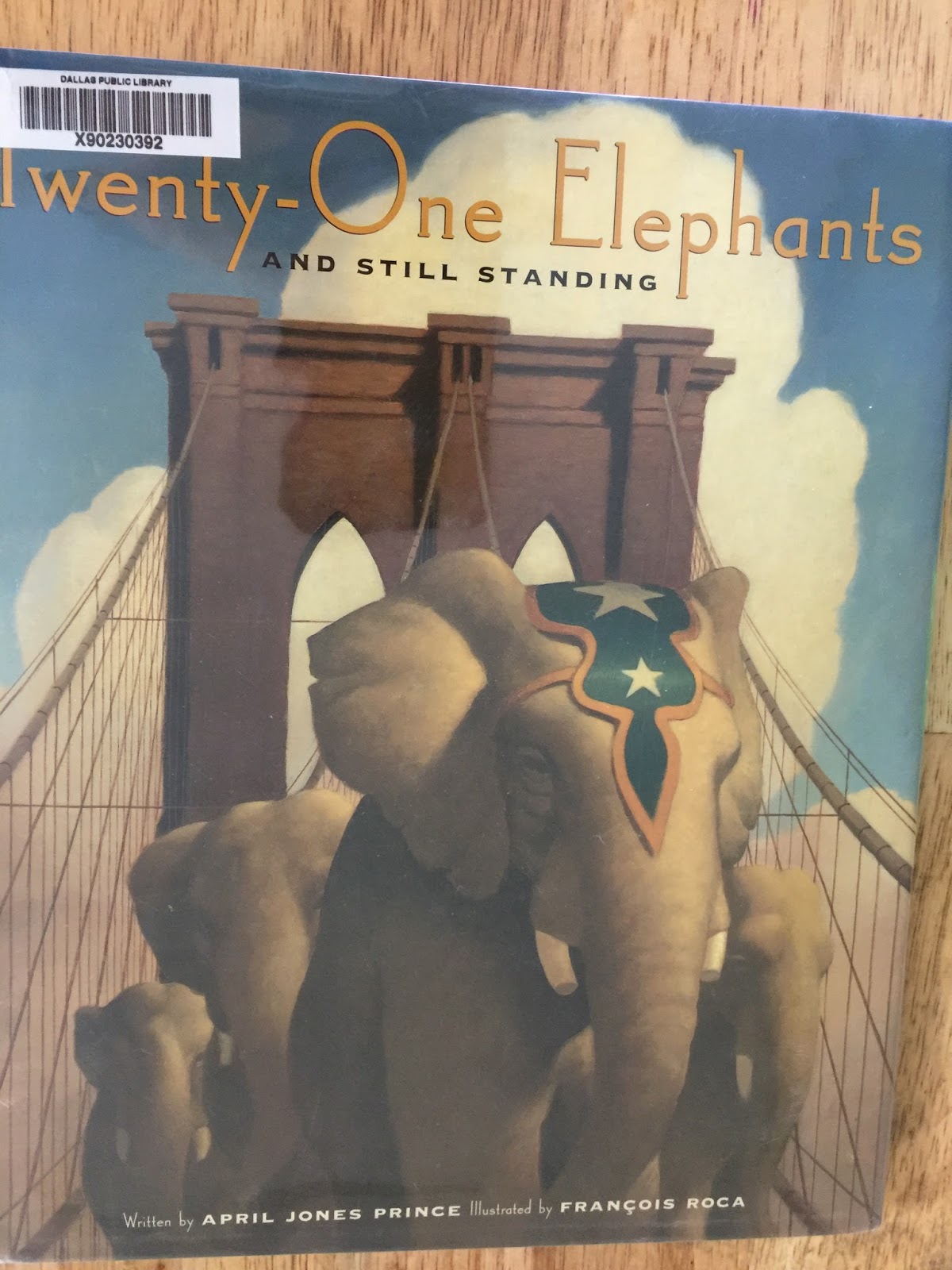
 For history this week we did the book, Twenty-One Elephants and Still Standing Written by April Jones Prince and illustrated by Francois Roca. I saw the book on Pinterest in connection to a fun STEM project and fell in love with the story. The story is about the construction of the Brooklyn Bridge and the subsequent distrust of the immense wood and steel wire suspension bridge. (The distrust was valid for that day and age, suspension bridges were relatively new and the Brooklyn Bridge was the longest suspension bridge of it's day.) PT Barnum heard about people's apprehension and saw the bridge as an opportunity for some publicity and to prove the bridges safety. As you may have guessed the elephants all make it across and the bridge deemed sound.

The book it self has amazing illustrations. The illustrator used beautiful watercolors to create a grand depiction of the era. The boys loved comparing clothing styles and I felt it
depicted the grandness of the bridge. What I was not ready for was the story. Don't get me wrong, I loved the story and the history. Additionally, I think poetry is a great way to tell a story. However, the vocabulary was WAY above an early elementary level (preschool-2nd grade). Examples of the "big" words would be: beguiled, gallant, dwarfed, savored, and infinite. I love vocabulary but when there is a 50cent word on every page, well it took us awhile to read the story. However, the language would have been awesome for 3-4 graders. Another book that is a little more age appropriate for younger listeners would be The Red Lighthouse and the Great Gray Bridge by Hildegarde H. Swift, which happens to be about a bridge not far from the Brooklyn Bridge. But sadly, no elephants...
J. Roebling

Speaking of age appropriateness  I originally planned on N adding the architect/civil engineer for the Brooklyn Bridge to his history book. Unfortunately, the original architect John Roebling died from tetanus from a construction site accident. His son Washington Roebling ended up overseeing and finishing his father's bridge. This was a fascinating fact (J. Roebling was actually a fascinating man) but not quite 1st grade material.


Anyway, on to the fun stuff!

1)Well, first we had to make Brooklyn and Manhattan! I had some old Amazon boxes lying around (they are a perfect size for crafting) and tempra paint. The rest was left to the three fellas imaginations. We cut some construction paper and folded little tabs to create the cities. They drew streets and used paper to create the East River. The boys loved making the cities, I think E even put a sea monster in the river. 


2)We were then joined by the boys' cousin,T, and after the story, he and N were given an engineering challenge: Create a bridge from Brooklyn to Manhattan that would hold all 21 elephant manipulatives. It was a great STEM exercise. Also, it presented a chance for N to learn to collaborate and problem solve with another student.
We (my sister and I) were amused and impressed by their results. N and T's first bridge made it across the river but did not fulfill the second condition of holding all 21 elephants. They made it the second time.   I also had 21 marbles if they needed more of a challenge but the math manipulatives were perfect.


3)I found this super fun paper craft on YouTube and it is really as easy as it looks! I would recommend using a lighter weight paper than construction paper. Here is the link for the how-to video!
Paper Elephant Craft


4) Lastly, N added his picture to his history notebook.

Supplies:
The Book (Twenty-One Elephants and Still Standing can be found in large libraries or you can buy a copy online.)
Construction Paper
Cardboard Boxes (2)
Tempra Paint
Colored Copy Paper
Manipulatives (21)
Blocks (I have Kapla blocks, Keva would work
or you could use thick craft sticks.)
Scissors
Gluesticks
Drinking Straws

Concepts Covered: Besides the previously stated history, watercolor artwork, poetry, vocabulary, life and customs of 1880's, civil engineering, bridge types, fine motor skills, and following directions.

What I Would Change/Add: In the future make a list of the vocabulary words and practice dictionary skills with N. I also wish I could have found a good movie or an actual circus to show the boys as it is a foreign concept to them.  Also, Dinotrux Season 4 Episode 7 show the characters building a suspension bridge. Silly as it may seem, the episode helped reinforced the bridge types and reasons you would want a suspension bridge. It was a great add-on after the fact.


Whatever you do, do it with all your might. Work at it, early and late, in and out of season, not leaving a stone unturned, and never deferring for even a single hour that which can be done just as well now.
 Phineas T. Barnum 


Whatever you do, do it with all your might. Work at it, early and late, in season and out of season, not leaving a stone unturned, and never deferring for a single hour that which can be done just as well now
Read more at: https://www.brainyquote.com/quotes/quotes/p/ptbarnum163291.html
Whatever you do, do it with all your might. Work at it, early and late, in season and out of season, not leaving a stone unturned, and never deferring for a single hour that which can be done just as well now.
Read more at: https://www.brainyquote.com/quotes/quotes/p/ptbarnum163291.html
Whatever you do, do it with all your might. Work at it, early and late, in season and out of season, not leaving a stone unturned, and never deferring for a single hour that which can be done just as well now.
Read more at: https://www.brainyquote.com/quotes/quotes/p/ptbarnum163291.html

Monday, March 13, 2017

100th Day of School

A month ago, my Facebook and Instagram were full of pictures of kids and teachers dressed-up for the 100th day of school. They were all so adorable! It looked like so much fun that I wanted to celebrate our 100th day of school but I did not feel like powdering my hair. Not to mention dressing like you are 100 years old when there is just you is not real exciting. Sooooo, I decided we conduct a a normal day of school from 100 years ago, in other words, like it was 1917.

Now I will be completely honest, I was nowhere near 100% authentic. I think I was wearing a knit dress and leggings, and I was not giving up my bathroom. However, we came up with enough ideas to be not only super fun but also give the boys the experience of how things used to be done.

Here is what we did:

The day started with getting dressed for school in cotton shirts and denim jeans. I explained that shirts were made out of flour sacks in 1917 and the coolness factor went way up. Also, no socks or shoes. It wasn't Sunday and it wasn't snowing, so no shoes.

The sink and fridge were off limits for drinks (no traditional indoor plumbing in schools). The boys had to ladle their water into cups out of a "bucket". It was actually a great eye-hand coordination exercise.


N favorite part was conducting school without utilizing paper. Everything was copied onto his slate from the board (math and phonics) or was a verbal quiz (reading). Copying and writing on a slate was a great exercise and I really should do this again to help strengthen his penmanship.

E's favorite was recess! We learned a "schoolyard" game. It was cold outside so I taped a square on the carpet and taught the boys how to play marbles. It took them awhile to figure out how to flick a marble (J never quite got it) but it was a lot of fun.

The week before, N and I did a unit on Alexander Graham Bell and discussed  different means of communication used before the advent of the internet and cell phones. So, for science/history on this 100th day of school, we learned about Morse Code and telegraphs. We made our names utilizing Morse Code by using: ponybeads for the dots, pieces of drinking straws for the dashes, and threading them on pipe cleaners. It was a simple craft (you can find samples of the Morse Code alphabet on Pinterest) but very successful. N has struggled with the idea of codes before but he grasped this concept fairly quickly.


But life in 1917 would not be complete without after school chores, 1917 style. So, N had the job of making butter for dinner. I placed some marbles in a large glass mason jar with heavy whipping cream and let he shake away. It definitely took some perseverance but after a little help from my electric mixer (teacher put to much cream in the jar, newbie mistake), we made butter! He got to do the semi-gross job of  rinsing the butter and squeezing the buttermilk out. All in all, we were shocked that it really worked and making butter was fairly easy. Who knew...

Our version of school in 1917 actually required very little extra work or planning from me, most of the items I had around the house. The boys had a blast.  And honestly, for a fun day we actually got a lot accomplished.

Items Used: cotton clothing, a large pot and ladel, a small chalk board, some chalk, masking tape, marbles, pony beads, drinking straws, pipe cleaners, a large mason jar, and some heavy whipping cream.

Concepts Covered: Besides the obvious historical information, we also worked on fine and gross motor skills, penmanship, eye-hand coordination, and logic.

What Would I Change/Add: Next year I will slow bake potatoes in the oven for lunch, along with an apple and cheese.